

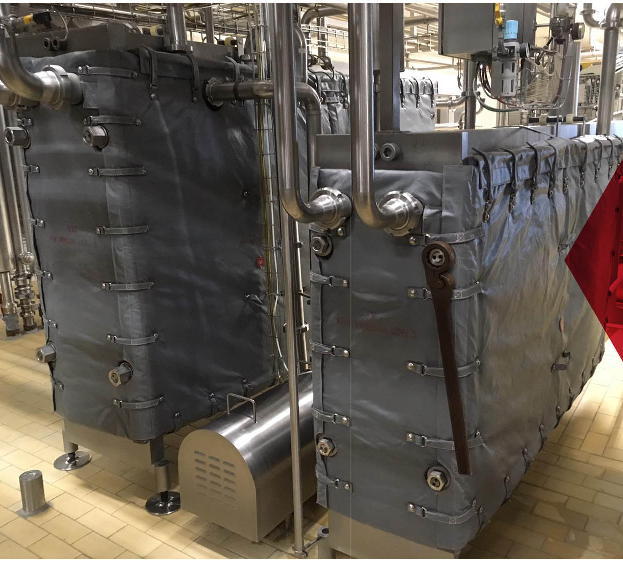
Heat exchangers, whose primary function is to transfer heat between two (or more) circuits, are another type of installation/equipment that should be insulated. Heat exchangers form a very broad group of devices which, depending on their application, may differ significantly in size and construction type. We will focus here on pasteurisers used in the dairy industry.
Efficient pasteurisation processes rely on maintaining controlled thermal treatment, i.e. heating a substance such as milk/cream to a pasteurisation temperature of 75°C–90°C. A pasteuriser may operate in continuous or batch mode. The condition for heat transfer is the presence of a temperature difference. Heat flows from a fluid at a higher temperature to a fluid at a lower temperature. The most commonly used heat exchanger in the dairy industry is the plate pasteuriser.
When a pasteuriser is used within a heating system, the unit releases part of its heat to the surroundings through its external walls. The larger the heat exchanger in terms of size, the more heat it can emit externally. Naturally, these are heat losses which should be avoided in well-designed heating systems.
Insulating pasteurisers with our SUM Higienic Guard covers reduces the surface temperature of the equipment and saves energy. SUM covers are widely used on installations located in close proximity to dairy products being processed in this case.