


High wholesale energy prices and the costs of purchasing CO₂ emission allowances were the main drivers behind rising bills in 2022 (source: URE – https://www.ure.gov.pl/pl), and consequently increased operating costs for many enterprises. As a result, companies are undertaking a range of measures aimed at improving energy efficiency in order to reduce production costs.
One of the most effective ways to combat high energy costs is proper insulation of all points where heat is unnecessarily released into the environment. SUM Guard technology can reduce energy losses by up to 90%!!! How is this possible?
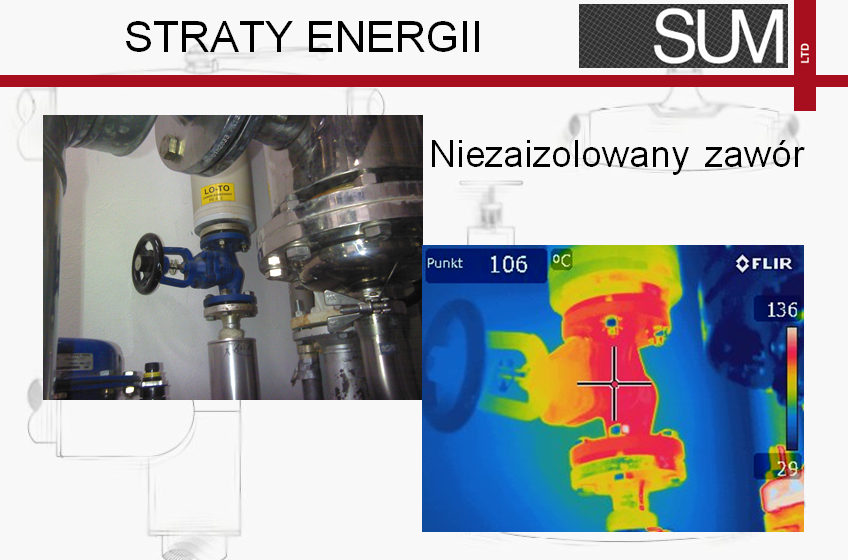
We invite you to review the examples below showing potential savings on standard shut-off valves, which in many plants remain uninsulated due to the need for frequent operation.
Energy losses are closely linked to the surface area of the fittings. Heat is emitted by everything—the body, the bonnet, the counter-flanges, and even bolts and nuts. Taken together, these form a very large total surface area.
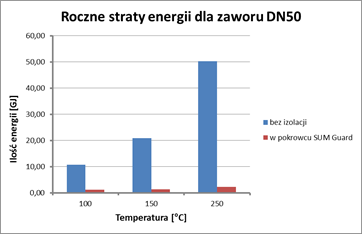
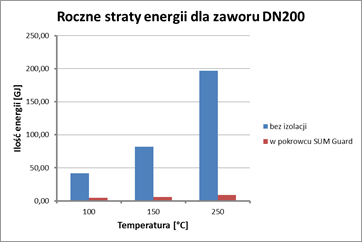
Example – shut-off valve DN 50 and DN 200

Another important factor is operating temperature. The relationship between these two parameters (fitting surface area and operating temperature) shows how significantly the lack of insulation impacts processes.

An uninsulated DN50 valve operating at 150°C results in an energy loss of 21 GJ (5,838 kWh) per year (8,000 operating hours). This is sufficient energy to cover the entire seasonal heating demand of an average new 70 m² house. Insulation using SUM Guard technology reduces losses by 90% and delivers savings of approximately 0.45 TOE*.
An uninsulated DN200 valve operating at 150°C results in an energy loss of 82 GJ (22,796 kWh) per year (8,000 operating hours). This is sufficient energy to cover the entire seasonal heating demand of an average new 280 m² house. Insulation using SUM Guard technology reduces losses by 90% and delivers savings of approximately 1.75 TOE*.
*) 1 TOE = 1 Energy Efficiency Certificate (so-called White Certificate).